Résumé
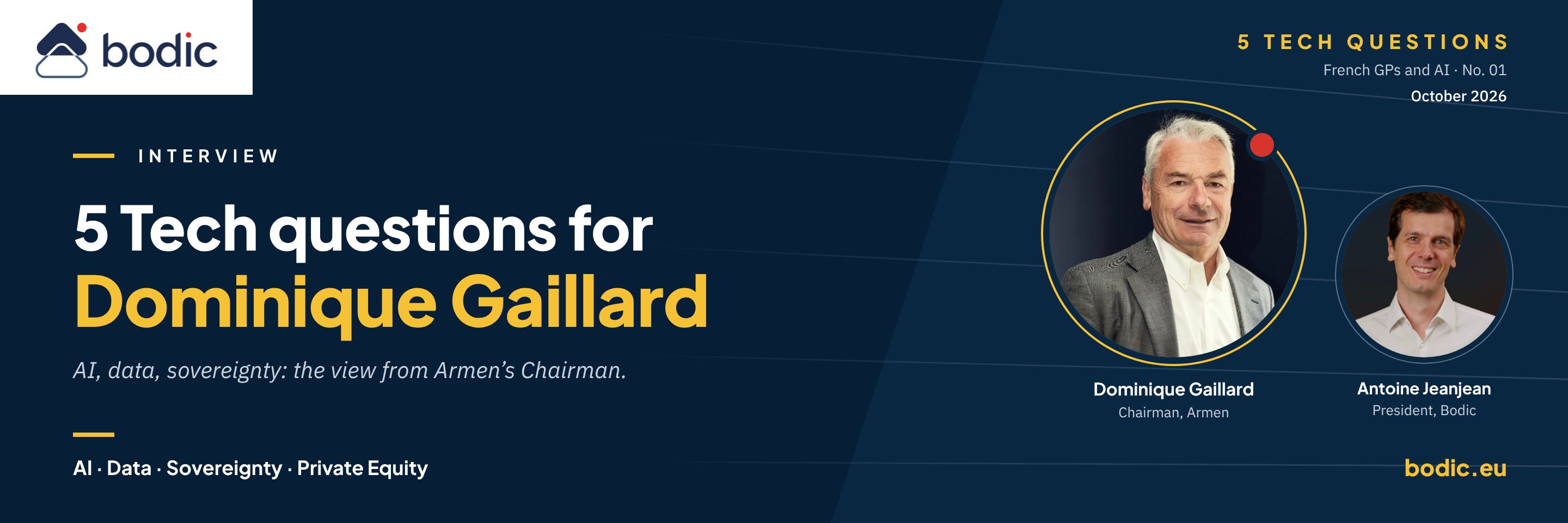
In connection with the #SIAI2026 conference on November 19, Dominique Gaillard agreed to answer five questions about AI, data, and sovereignty to introduce the topic and share the vision of the ARMEN staker GP.
Co-founder of Ardian and former president of France Invest, Dominique Gaillard now chairman of Armen, a GP stakes platform that takes minority stakes in European asset management firms. He answers our five questions on AI, data, and sovereignty.
1. Strategy
Antoine Jeanjean: AI is on everyone’s lips. In practical terms, how has it already changed the way you invest, and what will it never replace in the GP business?
Dominique Gaillard: GP stakes is a young industry. There aren’t thirty years’ worth of databases, and we have few comparables—unlike the LBO segment, for example. So we’ve had to build our own analytical frameworks, and they’re very data-driven: the GP’s track record fund by fund, the quality and diversification of its LP base, the dynamics of its portfolio, the ambition and quality of management, the strength of the team, and the level of digitalization. AI helps us collect and structure this information, read hundreds of documents, and identify inconsistencies.
What it will not replace is judgment. In the post-mortems of my 35-year career, risks were always clearly identified, but never properly quantified. AI will do an excellent job of listing strengths, weaknesses, and risks. Deciding how much weight to give them and taking a position—that remains the investor’s job.
2. Portfolio Companies
Antoine Jeanjean: With Armen, your portfolio companies are themselves management firms. What distinguishes those that have embraced data and AI from those that are merely adapting to it?
Dominique Gaillard: The difference isn’t in the tools; it’s in how the team operates. The asset management firms that have embraced this shift have their own centralized and shared data: a dynamic CRM, up-to-date portfolio tracking, and a fund history that doesn’t depend on each partner’s email inbox or phone. On this foundation, AI becomes a true co-pilot: preparing for a committee meeting, retrieving what an LP said two years ago, summarizing the reporting on an investment. Those that are struggling with this situation end up with a pile of Excel files and tools that don’t communicate with one another, and AI only adds another layer of confusion.
For an investor in GP stakes, a management firm’s level of digitization and its willingness to adopt new technologies have become full-fledged criteria for analysis and selection, on par with performance or the LP base. This is a good indicator of its ability to raise its next fund and ensure the long-term sustainability of its organization.
3. LPs
Antoine Jeanjean: Your LPs are demanding ever-greater transparency and reporting. Will AI transform the GP/LP relationship, or will it merely speed up the production of PDFs?
Dominique Gaillard: If it’s only used to produce more PDFs faster, we’ll have missed the point. LPs aren’t lacking data; they’re lacking tailored answers. Being able to respond quickly and precisely to an LP’s question—using the fund’s data—without tying up three people for two days will soon be the norm and the standard to strive for. It’s also about maintaining a record of the relationship: what an LP asked, how we responded, and their specific constraints.
The time saved must be used to strengthen the dialogue on strategy and value creation, because fundraising remains a matter of relationships and trust. This is, in fact, what we look for at Armen and seek in our portfolio companies: a management firm that knows its LPs well and serves them well raises capital more effectively and consistently. Transparency is no longer a time-consuming burden; it’s an advantage when raising capital.
4. Digital Sovereignty
Antoine Jeanjean: Data on your LPs, your deals, and your portfolio companies—is digital sovereignty, for you, a regulatory constraint, a criterion for choosing your tools, or even a blind spot in the French private equity industry?
Dominique Gaillard: All three, in reverse order. It’s still a blind spot for much of the industry: many management firms have entrusted their most sensitive data—that of their LPs and portfolio companies—to U.S. tools without really thinking about it or simply by default. It’s becoming a selection criterion because European institutional LPs are now raising the issue during their due diligence, and because a fund’s data is its strategic asset. And it’s a regulatory constraint that’s going to become stricter.
For Armen, it’s also a key factor in evaluation. A GP that knows where its data is and has access to it is a GP with strong governance. That’s why Bodic was created at Armen: we couldn’t find a tool on the market that met this need, so we built it ourselves. And I believe this work should benefit the entire ecosystem, not just us.
5. Teams and the Future
Antoine Jeanjean: What will an investment team look like in 2030? What kinds of candidates will you recruit, and what advice would you give to a young analyst just starting out in the field?
Dominique Gaillard: A team freed from repetitive tasks, but not from making judgments. Each professional will have a digital co-pilot that prepares, retrieves, and synthesizes information, and serves as the fund’s memory: committees, meetings, and documents received. The time saved must be devoted to fieldwork, executives, and LPs. That said, I don’t believe specialists will disappear. Sector experts and specialized advice will still be around in ten or fifteen years, because generic AI cannot replace expertise.
We’ll recruit candidates capable of doing both: reading a balance sheet and analyzing data, and above all, engaging in strategic thinking. My advice to a young analyst can be summed up in one sentence: read the full reports, not just the summaries. Memos have become smooth, uncontroversial copy-and-paste versions of due diligence reports. Value, today as in the past, lies in having taken the time to form a conviction and knowing how to defend it.
Other articles