
Is it possible to effectively automate equity investment reporting?
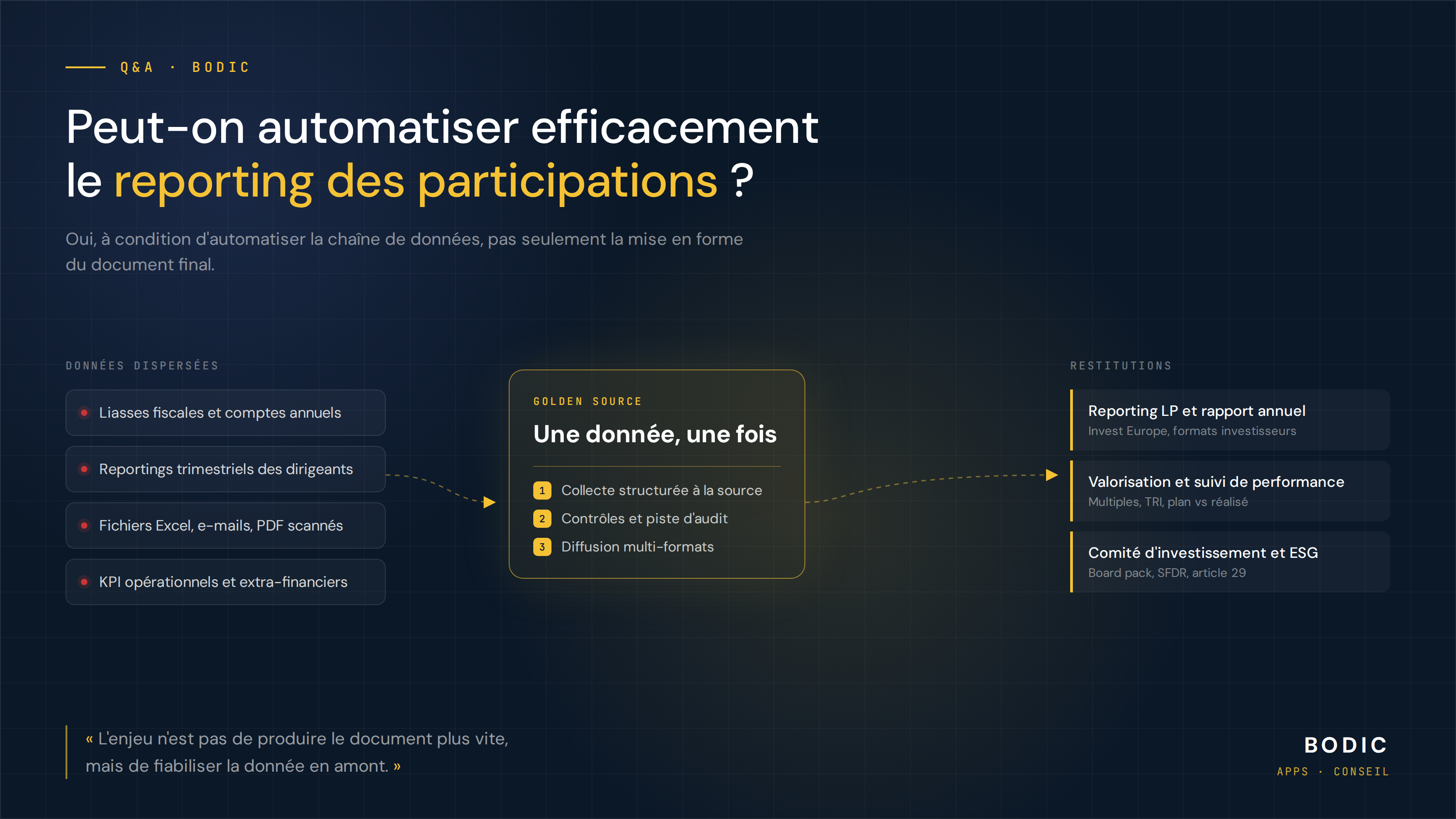
Yes, provided that the data pipeline is automated—not just the formatting of the final document. Most projects fail because they focus on the “last mile”—the LP report or board pack—when the real cost lies upstream: collecting, re-entering, and validating information produced by third parties in different formats and on different schedules.
Three levels of automation, in order of increasing value. First, data collection: a structured data entry portal open to executives at portfolio companies replaces the back-and-forth email cycle and makes the closing date predictable. This is the most significant—and most underestimated—source of savings. Next comes verification: consistency with the previous quarter, variances from the budget, and completeness, with an audit trail that answers the question, “Where does this figure come from?” Finally, reporting—which becomes a simple matter once the data is consolidated, dated, and validated.
There remains one line that must not be crossed. The selection of comparables, the treatment of an exceptional event, and the commentary provided to limited partners are matters of the manager’s judgment. The goal is not to remove the human element, but to reallocate it: less time spent fabricating the numbers, more time spent explaining them.
This is the approach adopted by Bodic Apps, where Portfolio Portal, Middle Office, and Golden Source share the same data rather than duplicating it. The preliminary framework, the set of performance metrics, and change management for portfolio companies are the responsibility of Bodic Conseil.
Three levels of automation, in order of increasing value. First, data collection: a structured data entry portal open to executives at portfolio companies replaces the back-and-forth email cycle and makes the closing date predictable. This is the most significant—and most underestimated—source of savings. Next comes verification: consistency with the previous quarter, variances from the budget, and completeness, with an audit trail that answers the question, “Where does this figure come from?” Finally, reporting—which becomes a simple matter once the data is consolidated, dated, and validated.
There remains one line that must not be crossed. The selection of comparables, the treatment of an exceptional event, and the commentary provided to limited partners are matters of the manager’s judgment. The goal is not to remove the human element, but to reallocate it: less time spent fabricating the numbers, more time spent explaining them.
This is the approach adopted by Bodic Apps, where Portfolio Portal, Middle Office, and Golden Source share the same data rather than duplicating it. The preliminary framework, the set of performance metrics, and change management for portfolio companies are the responsibility of Bodic Conseil.