
Questions & Answers

Find the main questions funds ask about AI, Data, sovereignty and the transformation of their operations.

2 results · #Human supervision

What is an AI agent in the context of a fund, and how is it different from a classic SaaS tool?
What is an AI agent in the context of a fund, and how is it different from a classic SaaS tool?
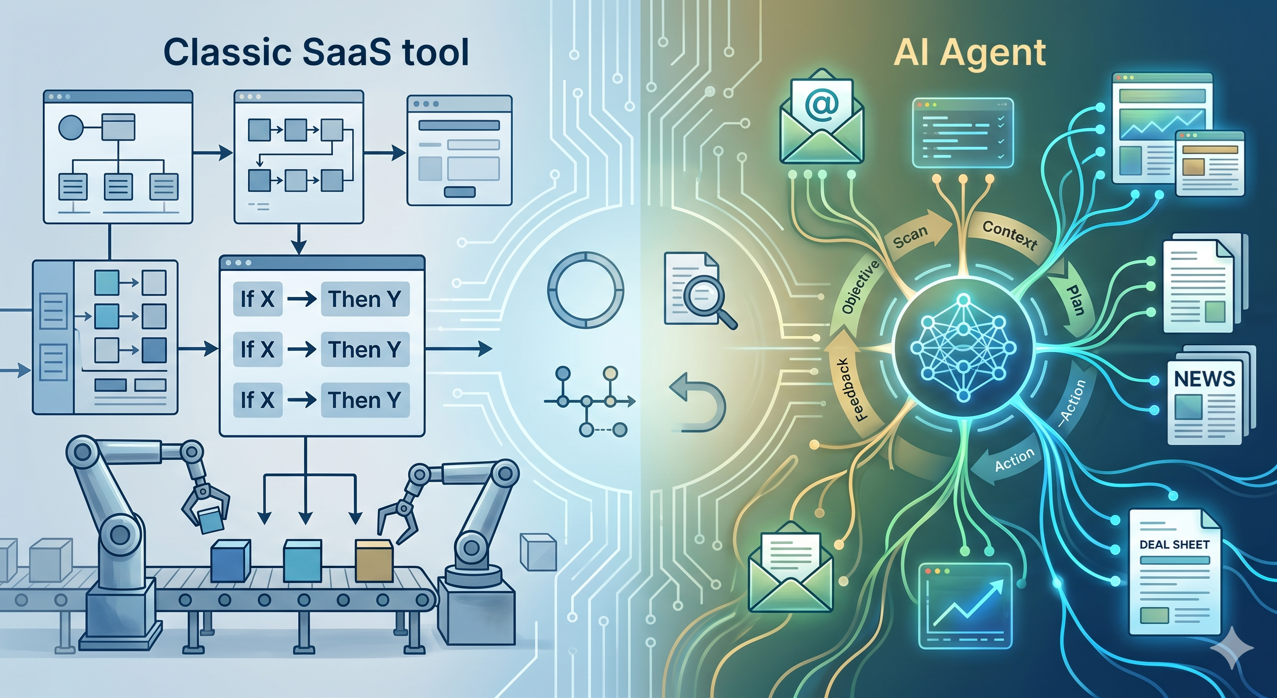
A classic SaaS executes pre-programmed actions: if X, then Y. An AI agent, on the other hand, receives an objective, understands the context, plans its steps and executes a sequence of actions, adapting to the data it encounters. This autonomy is both its interest and its risk.
In a fund, the relevant use cases for an agent are well-defined: processing supplier emails, enriching a deal sheet, automatically preparing a committee pack from a data room, monitoring signals on target companies. Ill-framed cases (making an investment decision, sending a communication to an LP without proofreading) are not cases for agents, they are cases for assisted humans.
A good agent has four characteristics: a clear perimeter, human supervision at every sensitive stage, complete traceability, and reversibility in the event of unexpected behavior. Bodic develops its agents according to these principles as part of its customized developments.
How to prevent an AI agent from hallucinating financial data?

How to prevent an AI agent from hallucinating financial data?
Hallucinations are the main risk when using AI agents in a financial context. They are not the result of random errors, but of the structural behavior of models in the absence of reliable or sufficiently constrained information.
Three levels of control can greatly reduce this risk.
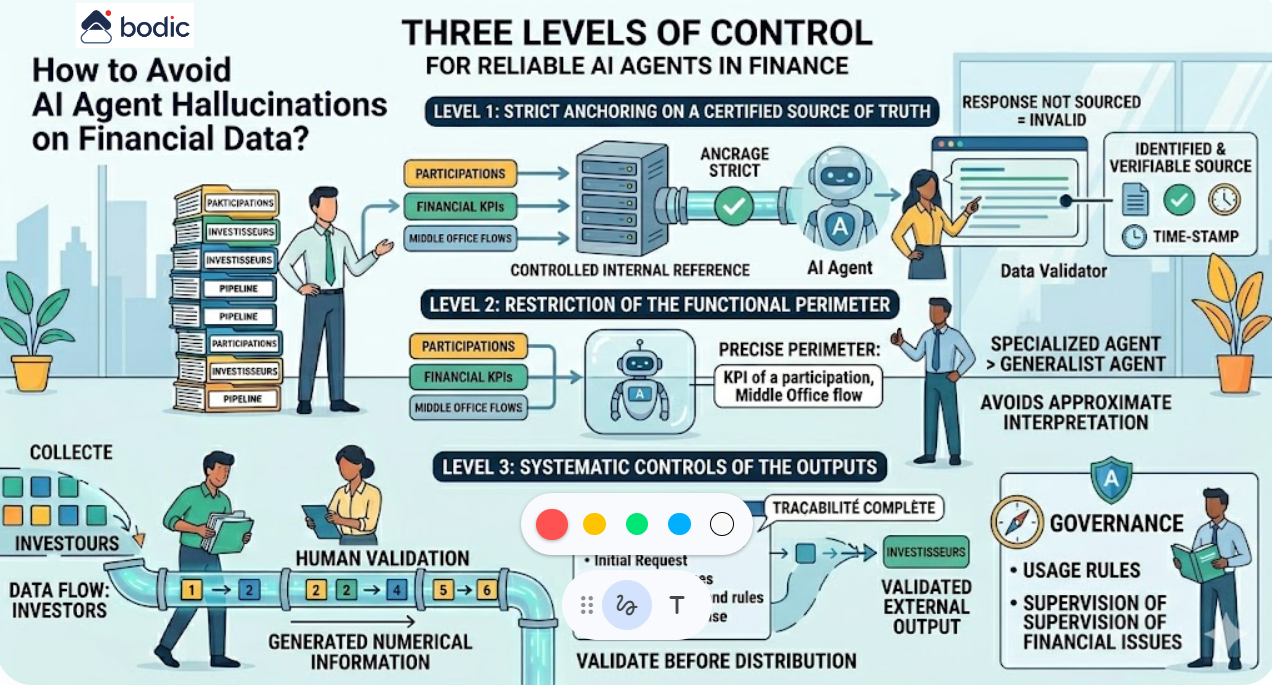
The first is strict anchoring on a certified source of truth. The agent must not rely on general knowledge or implicit data, but only on a controlled internal repository. Each answer must be associated with an identifiable, accessible and verifiable source. An unsourced answer must be considered invalid by default.
The second level is the restriction of the functional and informational perimeter. An agent must intervene in a precise domain, with a limited and controlled set of data. The wider the scope, the greater the risk of approximate interpretation. In practice, an agent who specializes in a subset of financial data, such as a shareholding's KPIs or Middle Office flows, is significantly more reliable than a generalist agent.
The third level is the implementation of systematic controls on outputs. All numerical information intended for external use, in particular for investors, must be validated by a human being. This validation must be based on complete traceability: initial request, sources used, transformations applied and response generated.
Beyond these principles, technical architecture plays a decisive role. A structured approach consists in isolating the AI layer from raw data, using a centralized repository, then exposing only validated data to agents. This allows precise control over what the agent can see and use.
Finally, it's important to treat hallucinations as a governance issue, not just a technical problem. This means defining rules of use, levels of responsibility and supervisory mechanisms adapted to the financial stakes involved.
A reliable agent is not one that "responds well", but one whose every response can be explained, traced and verified.